
In the 8 years I’ve worked on products enabling collaborative applications of robots, there’s been one pervasive assumption from folks receiving them. They want the robots (from arms to AMRs) to zoom up to a person, pause for the interaction, then zoom off again so the robot can keep up with how fast a person can move between tasks. Even for AMRs that are moving between endpoints alongside people, folks ask if they can go faster. They see how fast robots can go when behind fences and want that same movement when people are around.
Basic physics makes that hope a myth. We need the robots to be safe and trustworthy around people. To get a sense of the potential force of a collision, we just need to think of it in a simple physics problem- 2 objects moving toward each other. Robots plus their payload can weigh well over 1000lbs/450kg and move at 6mph/2.5m/s, and the average person weighs 136lbs/62kg and can walk up to 3.5mph/1.6m/s. That’s an average horse jogging at you while you walk at it, it’s potentially dangerous. So we need to have the robot go around, slow, or stop to prevent collisions. Operational areas for these robots don’t always have space to safely go around and they need space to see you and apply the brakes, so they have to drive slower frequently to keep the people safe.
Trust is an often overlooked part of safety. People need to trust that robot will stop for them or the collaborative throughput of the application is going to be sub-optimal while the people make modifications (going around or stepping back) to feel safe. Going back to the horse analogy, most people wouldn’t trust a horse trotting right up to them and stopping inches away. Some folks would, but that’s because they 1. trust that specific horse 2. see the horse sees them 3. trust the ground has enough traction to let the horse complete the stop. And if the horse misjudges and collides with the person we’d understand, because it’s a horse or the person chose to allow that situation by being there. If it’s your job to have to stand there while a robot approaches, that robot needs to be even more trustworthy because it’s expected to be more reliable than a horse. And in reality the horse has better sensing, controls, and judgement than robots currently do.
Will we get to the point someday that robots will have good enough sensing, controls, and logic to zoom up to you and stop? Probably, but the question is if people would ever fully trust them to do it? And if not, that vision will still remain the myth it is today.
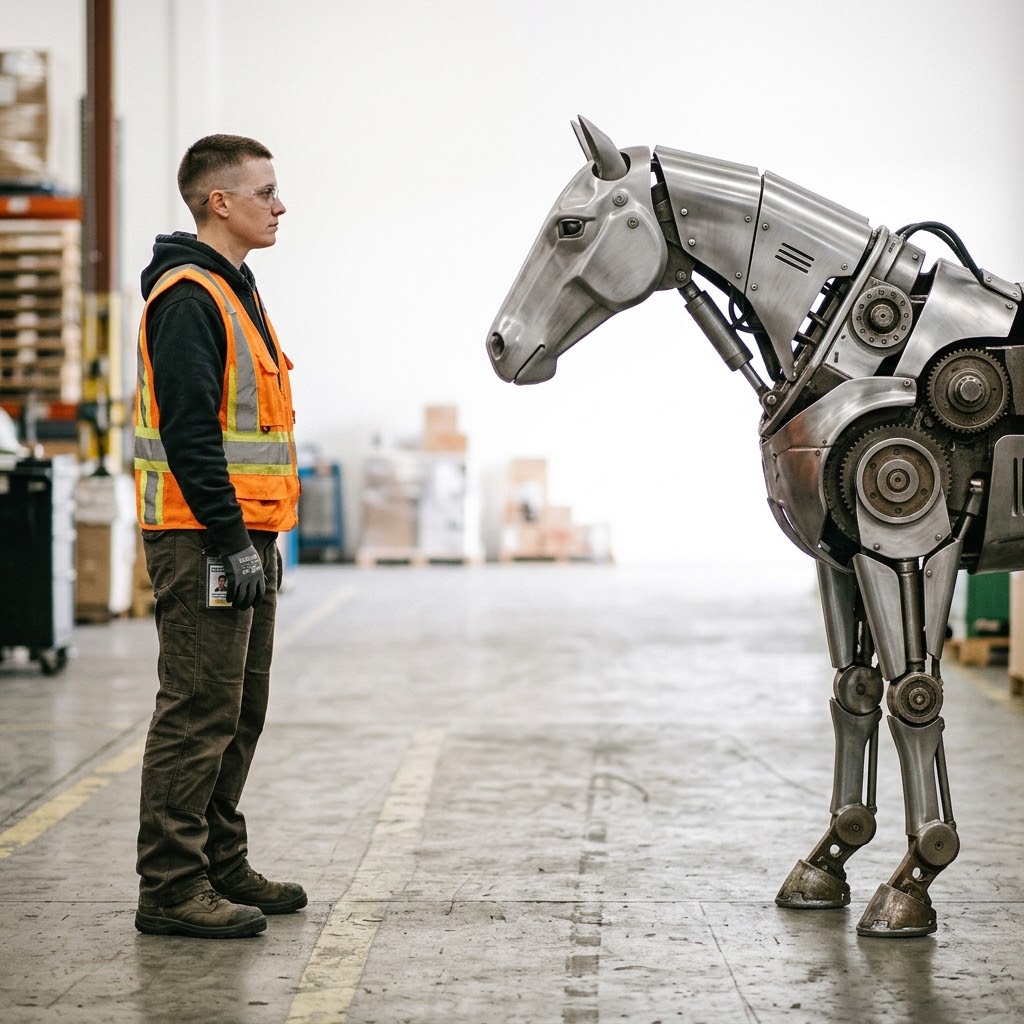
Image is AI generated, the post text is not.