
tl;dr – Oh goddammit. It’s all outcomes, all the way down.
Ahhh, a writing advice post! Truly, the least welcome professional development reading out there, with networking advice a very close second. But like every writer who thinks they’ve cracked the magic code, I feel the need to spend our mutual time talking about the craft so let’s get into why writing advice sucks first.
Writing advice, and particularly professional writing advice, sucks because people love to tell you the what and never the how. As an alumna of a John Dewey school1, this is the perfect opportunity to share how I best learn things: by demonstrating and doing.
So, we’re going to walk through how I wrote this essay in particular, in real time, as I do it. Extra bonus: I’ve been diagnosed with and treated for ADHD for over thirty years, so if you’ve got some neurospice this may actually be helpful.
We’ll lay out our tools first. A simple text editor (this is being written in the Apple Notes app on a Mac, but my preferred iOS text editor is iA Writer), and this being the year of our dark lord 2026, an LLM (I’m using a custom tool on top of Claude Sonnet 4.5, loaded up with plenty of my previous writing examples for context).
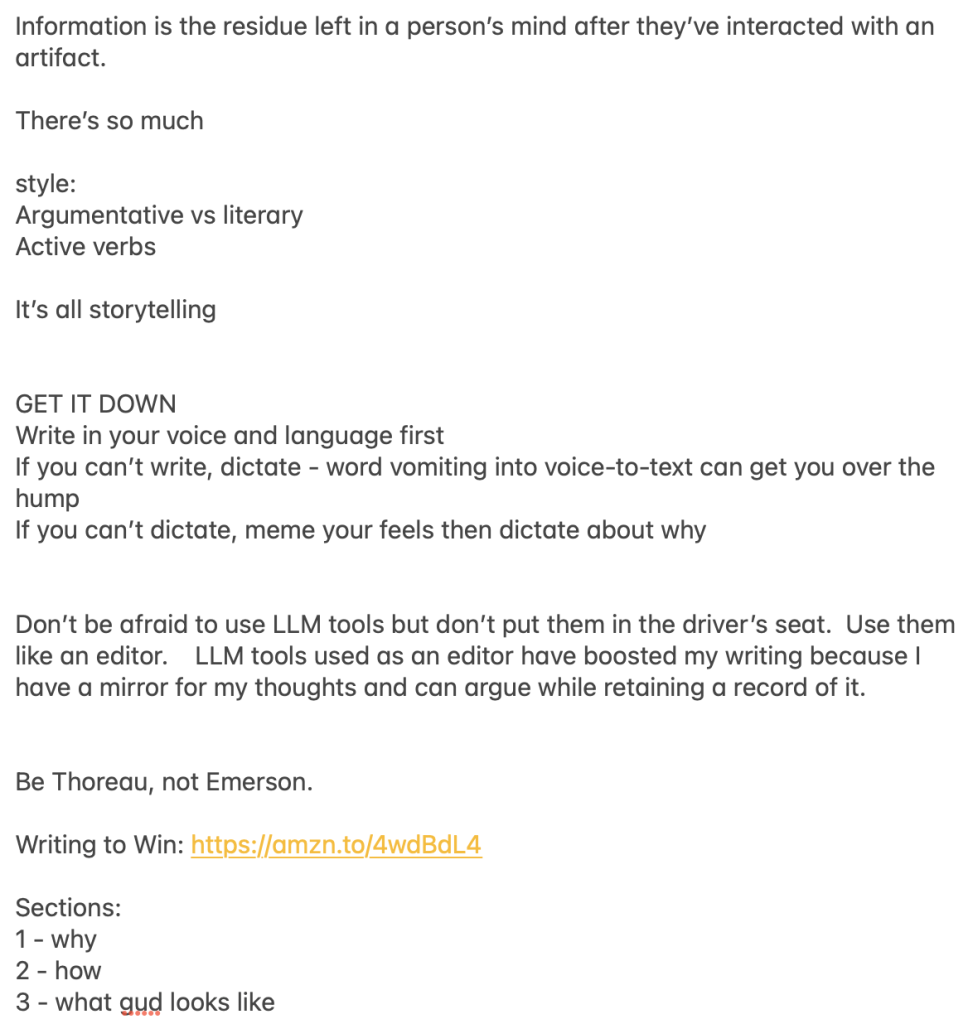
So, this post has been haunting my backlog for a bit, ever since I wrote about the problems with contemporary Amazonian writing culture2. How did it bang around, exactly? Well, I had started a Notes file after a colleague’s requests for advice inspired me to say “hey, I should write something about that”. Over the last few months I collected some half-formed thoughts, quotes, resources, and vibes. For something I’m angry about, I’ll take advantage of the drive home and turn on voice-to-text in Voice Memo or Just Press Record and just rant. Sometimes I include memes of pictures or whiteboard drawings in these files too and maybe voice dictate about them later, but this one happened not to have any. Whether I use all of these thoughts is irrelevant, what matters is that I got it down3. Here’s what that looked like:
This morning, my colleagues and I had a bit of a spicy Slack discussion about how we despised being served AI slop by others4. That conversation motivated me to actually start fleshing this whole thing out, after sitting on some vague notions for a few months. That’s okay, sometimes the tea needs time to steep.
So I sat down, noticed that my mug was empty of delicious milk, and decided to power through it because I finally had an outcome to focus on: I want people to write not-slop, and want to show them how to use LLMs to help write not-slop. I fired up my LLM and informed it as such.
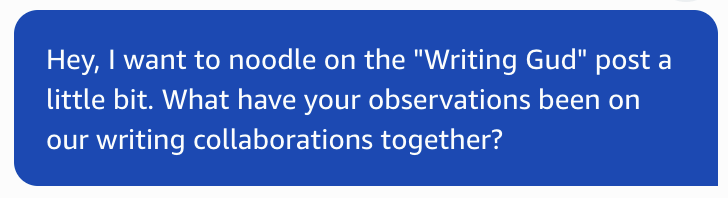
And… I got an answer, but not exactly what I asked for. The LLM responded with discussions about how to write in my specific voice and the themes I use. But that response in itself inspired me that this had to be a mechanics exploration. That dissatisfaction alone helped clarify what I wanted to do.
I started using LLMs to help me write things I didn’t want to write: status reports, resumes, and angry emails that needed some post-production to take the tone down. I tried using them the way everyone told me to: just have the LLM spit out the report and send it, but I was never happy with the results because they never seemed to actually explain anything. What I did learn, however, was to use the LLM as a mirror to reflect on what I say that I want to do versus what outcome I actually want to produce5.
I then explained that I wanted this to be a “how-to” post to demonstrate what successful collaborations, like the one I was experiencing with the tool, could be like. Some back-and-forth with the LLM on the purpose of the essay and the structure further made me realize that the best way to approach this was actually through the meta: let’s write a blog post while talking about how we’re writing the blog post.
And with that, boom: we have our stinger line for the piece above, and an easy introduction paragraph. I wrote the first couple hundred words in my Notes app, then pasted them into the LLM.
This is typically my writing flow these days: I write separately in the Notes app, then share every paragraph or so to the LLM via copy-and-paste. I find it very difficult to maintain a sense of agency and ownership when I have the LLM build the artifact for me. The LLM then offers feedback on themes, theses, structural clarity, and what could be next based on the immediately prior conversation about structure and intent.
BTdubs, I just had a thought about how I should tell you about my neurospiciness, and added it to the intro paragraphs. So I’m now going to copy and paste the whole thing so far back into the LLM to see the full progress.
The delay between sending a prompt and getting feedback from the LLM has actually become a feature for me because it forces me to sit quietly with what I’ve written so far and what I yet want to bring up. Plenty of random thoughts get added into my raw notes section below at these times. Same energy as when you leave a conversation with someone and realize a banger of a point you should have brought up.
So I’ve got a bunch of notes, a concept of a plan, and some intro written. Let’s get into the purpose of writing.
Information is the residue left in a person’s mind after they’ve interacted with an artifact6.
Before any of the structural stuff, before raiding the Chicago Manual of Style7, before font choices, before any of that… what outcome do you want from someone reading this piece? What do you want them to have learned or to have decided? If your only goal is to write something because you were told to write it, you’ve flunked already8.
Note that I footnote my blog posts heavily with occasionally shitty snark. You should be having such opinions while writing constantly, regardless of whether you publish them in the final draft. Keeping your snarkiness in the document while writing it ensures that you don’t lose the vibe you’re trying to get across. In professional writing, these can become sentences that end with a silent “you fuckers”.
Okay, so now that we’ve hit another tangent, let’s go ahead and feed back into the LLM. I’ve added a couple of footnotes throughout the draft and massaged a couple of word choices, so we’re going to copy and paste the whole thing up to this point.
The LLM points out that I’ve abandoned my original structure completely in favor of the meta-narrative. And that’s not a bad thing! No plan survives contact with the enemy9; we’re following the story where it needs to go. The value of the planning and the structure discussion was entirely in talking through what needs to be told in the story.
And good writing, even professional writing, is all story telling. It’s how human beings learn10. I am telling you a story, right now, about telling stories.
So take a page from fiction. My partner is a huge Jim Butcher fan, starting with the Dresden Files series and expanding into Butcher’s other works. As a result, I’ve been exposed to far too many Youtube interviews with the man where he nominally talks about his various book series but often goes into his writing approach. Certainly, you could work up character sheets for your main topics and actors, but how do you think about building up the tension that keeps a reader engaged? What questions exist at the beginning of the piece that need to be answered by the end?
Or perhaps you’re jumping into the middle of the story, in media res, as all great epics11 and many professional update documents do. What do we need to know right now? What can we learn along the way? What parts of the existing culture can do some referential work for us?
This story started at the beginning. I told you about what outcome I wanted to hit, what motivated me to get started, and about the process I’ve been using. You’ve been on this writing journey with me all day today. It’s only been a couple of intermittent hours at the keyboard but I’ve shared so much more with you.
We have the outcome, the structure, the story questions. Now let’s get into style.
I’ve sent this previous section over to the LLM; I was concerned about getting too far off into the weeds and wanted to see what my editor here thought. The LLM pointed out that I needed to connect the in media res portion back up with how I started the story at the beginning, so I’ve added some pieces that allude to professional update documents. You can’t write those as episodic chapters because you must assume that the reader is coming into the project with no prior knowledge.
But, now that our story has a complete arc, back to style.
Here’s where I blanked. I’ve shared plenty of my writing philosophy, personal preferences for my voice, and writing resources with my LLM. But, for the life of me, I can’t figure out a way to express the vibe. The LLM offered a few entry points based on my notes such as Thoreau vs Emerson, argumentative vs literary vs narrative, among others. What these options are really doing is helping me realize that we need to explain what style is first before we can apply it.
Turns out, I’ve never thought deeply about style before simply because I’ve always applied it implicitly. And I might not have had that realization had the LLM not reflected that lack of intention back to me from my own writing. Actually a little embarrassing considering how much I go back to the Chicago Manual of Style.
Style is all about the how. It’s the culmination of the words you choose, how you apply them, and how you develop the tone to build the persona of who is speaking to the reader. Whose voice do you want the reader to hear when they read your words?
Our communication styles are composites of all of our experiences. If you’ve ever heard something come out of your mouth that sounds exactly like your parent, that’s evidence that they’ve influenced your communication style. We also develop different communication styles depending on what environment we’re in and who we’re speaking to12. For example, my neutral accent is highly legible to European listeners, but once I get tired or irritated the South Side of Chicago comes out real strong13.
We speak about 12,000-14,000 words a day14; by contrast, professional writers target 1,000-2,000 written words per day while us amateurs write far less. That’s an order of magnitude of difference in time spent simply developing one’s voice.
Sure, you have to write more to write well, but there’re resources out there so you don’t have to develop everything from first principles.
(This is the point where the LLM is absolutely kicking my ass about giving it my footnotes, by the by.)
My argumentative style shows direct heritage from my US History AP teacher15 who also happened to be our school’s Model UN debate coach. He emphasized that we should be Thoreau, not Emerson; that is, favoring terse, plainly worded statements (“The mass of men lead lives of quiet desperation”) versus verbose, flowery, albeit grammatically correct prose. That we take care to remove passive verbs from our drafts whenever feasible. That we start our narratives with the most powerful statements up front, instead of building to a crescendo at the end.
In my first attempt at college, I wrote blog posts criticizing the college administration and student government16 and had been fascinated by the hard-boiled edge of Harlan Ellison’s writings and the biting reference-fest that were Dennis Miller’s early rants (look, it was a different time and it was before he went crazy, okay?). Short stints of trying on those voices to understand how they worked got me a steady audience and a bit of a character I could play to express my frustrations.
Later, I found Writing To Win, which aims to make lawyers who can write a cogent brief but is so readable that you can plow it cover-to-cover.
Not a single one of these experiences can account fully for my voice today, but they’ve been hugely formative.
My last trick on the style pass is to read the piece out loud to a live victim, ideally a human but sometimes cats and Canada geese work as suitable stand-ins. This reading aloud part is where I realized I had to go back up and add the bits about “brain-dumping into voice-to-text while driving home” to bring it full circle, because it’s about using that same part of your brain: how do you tell the story? Does it make sense coming out of your mouth? Is it too chewy, too complicated, too hard to say? Do you lose the plot?
All right, we hit outcome, structure, story, and style. You’re all clear, kid, now let’s blow this thing and go home.

For reassurance more than anything, I slipped the LLM the line above to confirm it’s a good bridge. I wouldn’t change a thing about it, I just want the affirmation of someone reading and reacting to it.
So we’ve gone through our own epic together of writing a pretty sizable blog post. And what’s the outcome?
Maybe this was just a long story about writing a blog post. Maybe it served to help me think through how and why I write things the way I do. But maybe it left you with some ideas on how to use a wider array of tools and resources to tell your own stories more authentically and effectively.
And now, at the end, we’ll do one last pass through the LLM for consistency and cohesion, then get it ready for some tasty WordPress formatting time.
- U-HIGH!!! ↩︎
- Amazon’s Writing Culture Is Eating Itself, because this blog is going to end up cross-referenced like an X-Men comic. ↩︎
- See Tina’s Maxims #10: WRITE. SHIT. DOWN. ↩︎
- “Meat proxies” is a perfect term for this behavior. ↩︎
- Analogous to rubber ducking. No, not the weird Jeep thing. ↩︎
- A blog post, a white paper, an angry email, an info poster… Stolen somewhat from the concept of cognitive artifacts in UX. ↩︎
- The only correct choice for writing proper American English. ↩︎
- Note that, even in paid writing, you need to look for the motivation of why a reader is bothering to spend their time perusing something beyond “I get $100 for 500 words on gas prices and therefore can eat tonight”. ↩︎
- Or, if you prefer Mr. Tyson’s approach: everybody has a plan until they get punched in the mouth. ↩︎
- And why teaching history as a series of dates to be memorized rather than experiences that can be learned from only demoralizes students. But, I digress. ↩︎
- Thank you, Homer and Virgil. ↩︎
- Which is why you should be angry at anyone complaining that a politician “faked an accent” when speaking to different groups of people. ↩︎
- sighs deeply …Da Bears. ↩︎
- Tidwell, Colin A., Alexander F. Danvers, Valeria A. Pfeifer, et al. 2025. “Are Women Really (Not) More Talkative than Men? A Registered Report of Binary Gender Similarities/Differences in Daily Word Use.” Journal of Personality and Social Psychology 128 (2): 367–91. ↩︎
- Earl Bell, RIP. You built my entire writing foundation but your grading methodology still sucked. ↩︎
- Yes, I’m aware that I’m underselling it a little bit. I have otherwise learned nothing. Also, hat tip to the Internet Archive, there’s actually an archive of inflatablewhale.com. ↩︎
