For the last thirty years or so, VCs who’ve gotten thought-endingly rich on web unicorns have grown accustomed to investing in the software formula: build a barely functional proof-of-concept, scale wildly, and hope that you can fix your architecture in the long term once you’ve got market traction. This shouldn’t be considered an anti-pattern in the software world; software’s cheap to modify and easy to deploy and maintain.
The problems start when you see folks try to apply this model to the physical world. Robotics is a heavily VC-driven industry, and given their conditioning these VCs expect software results from integrated human-software-hardware megasystems. Shit no worky. Robotics can’t outrun their runway the way software startups can because the drivers are fundamentally different1. We’ve spent billions incentivizing flashy demo videos and short-term thinking, and as a result time and time again we see robotics companies fall over and sink into the swamp.

So what happens when you instead build not just for the next demo video, but the next decade2? How do you even do that? What does that look like? What do you need to keep in mind?
Well, you’re gonna need to build for the product lifecycle. There’s lots of courses and books you can read and probably some bullshit certification or another out there, but when was the last time you were able to take a generic B-school diagram and actually apply it to reality?
As one of the few humans who has actually owned every part of the product lifecycle for mobile robots, I feel eminently qualified to explain what that lifecycle looks like for us, who it affects, and why they need to care at each stage.
So, with that… welcome to the first half of the first part of a planned nine-part series3 that we’ll use to explore all the little nooks and crannies of the life and times of a durable capital product like a mobile robot. It’s life, Jim, but not necessarily as we know it.
Today, we’re going to lay some foundations. Then, in subsequent posts we’ll explore each lifecycle phase in greater depth. We’ll work backwards, from grave to cradle. Firstly because everyone starts at the beginning because that’s where the sexy stuff for investors and engineers lies; and secondly because winding something down gracefully affects your requirements and business processes at least as much as how you start it.
We shall start with some taxonomy. Guards, the doors please.
Product Classes: Barbarian Halflings Only, Please
Before we go any further, we need to clarify the kinds of products that exist. Unlike in the consumer realm, when you buy a banana or an iPhone you’re generally only going to have that product fall into one goods class, we’ll actually need to be touching and planning for all of them.
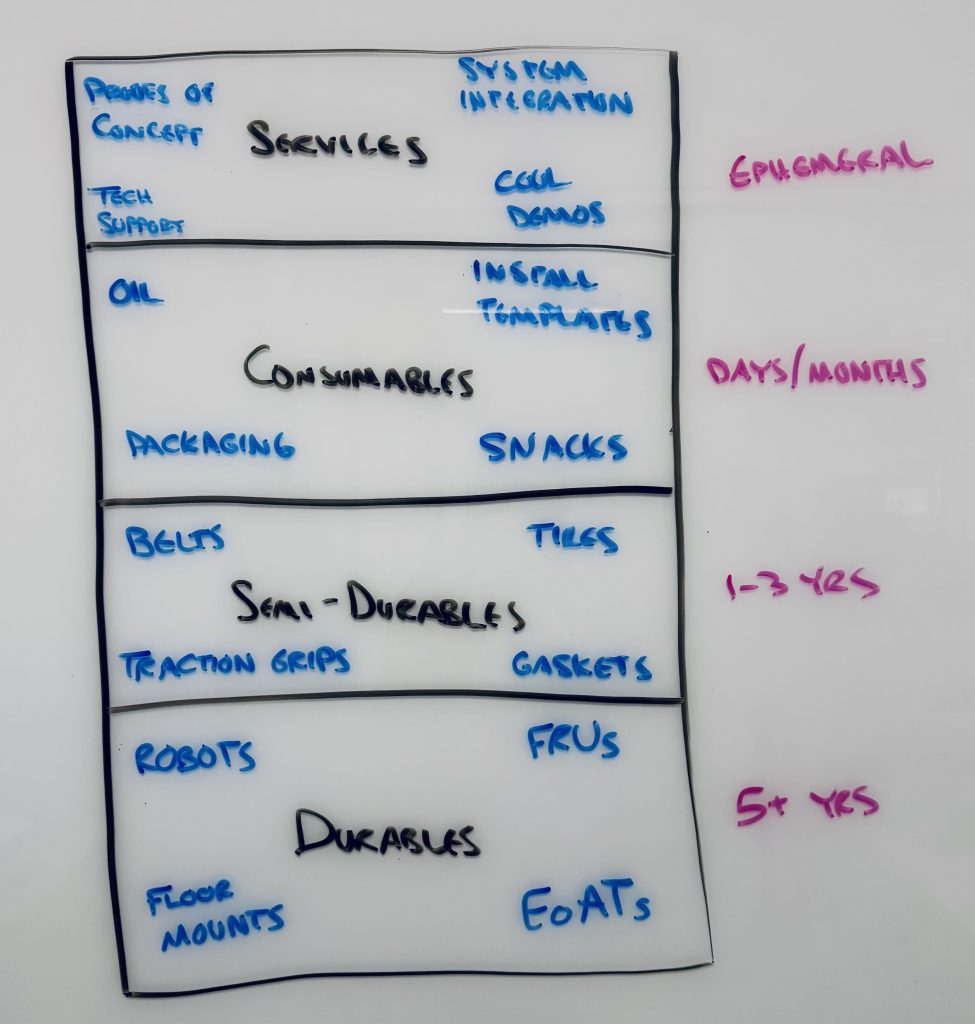
Services
Durability: Ephemeral
Financial type: Operating Expense
You’re purchasing the capability of a person or a system to produce an outcome for you. Whatever provides those actions goes away the moment the outcome is complete. System integration, tech support, and service contracts all seem obvious members of this class but I’m putting demos and proofs-of-concept in here too because they’re not intended to outlast getting the contract.
Consumables
Durability: Days or months
Financial type: Operating Expense
You’re buying stuff that will either get used up completely or disposed of in a short period of time. Oil and fuel and snacks are obvious members, but some invisible members include things like installation jigs and templates or packaging or marketing materials4.
Semi-Durables
Durability: 1-3 years
Financial type: Operating Expense
Stuff that we expect to be used up, but on a longer time scale than a consumable. Often unhelpfully called “consumables” in supply chain contexts, you’ll see tires, belts, traction grips, gaskets, and that sort of thing in this bucket. Typically these may have a lot number but may not be serialized and tracked individually.
Durables
Durability: 5+ years
Financial type: Capital Expense (mostly)
The big investments. The kind you need executive approvals for that will impact your organization for years if not decades. You’ll have legal and regulatory responsibilities for these for as long as it’s running, anywhere. Mobile robots, semi-structural installations, end-of-arm tools are all capital durable equipment. Field-Replaceable Units (FRUs) get treated like capital equipment when bought in large batches but as operating expenses when bought in one-offs, making the accounting a little fiddly sometimes. Finance bros typically treat software as durable goods, though they prefer to amortize it as an intangible asset rather than depreciate it like physical durable goods.
Note that any sort of lease scheme or *-as-a-service lands the ‘bots as Durables for the seller, but Services for the customer, even if the customer is expected to maintain them. Look, let’s all just be glad we’re not dealing with the mess o’ arbitrage that is international shipping, okay?
What’s In A Lifetime, Anyway?
The English lexicon contains about a half-million words and we still manage to overload every useful one5. Product lifetime is one of them, and yet you’ll never encounter this problem until you’ve actually had a product live one out completely. So, let’s take a look and make sure we’re accounting for each of these kinds of lives.
Throughout this series, I will use the term clock to differentiate these types of life from lifecycle/maturity phases.
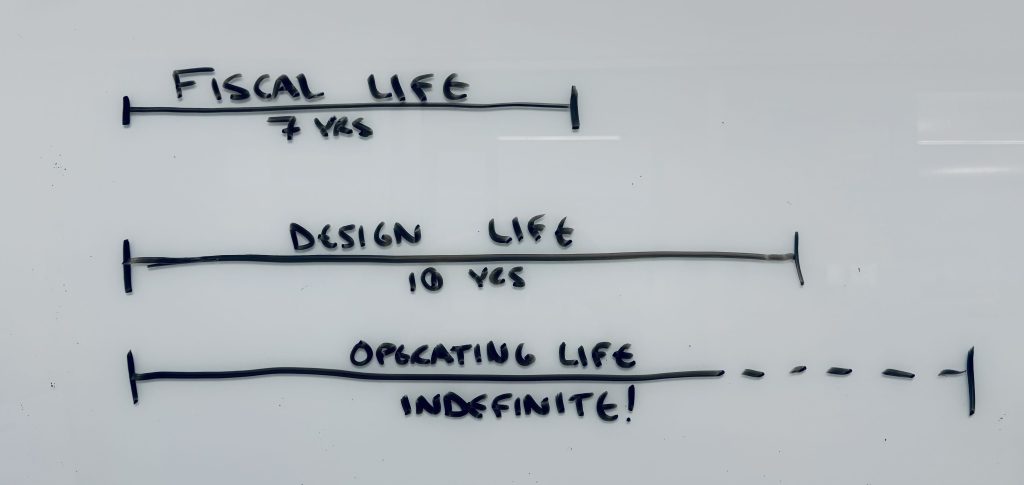
Fiscal Life
What your spreadsheet jockey will amortize the cost of the equipment to; typically 7 years. This has an interesting effect on how businesses think about equipment; suddenly, it’s basically free to keep using and now you’ve got an incentive to keep it running. For us mere mortals, it’s analogous to paying off your car note.
Design Life
The length of time you’re promising the customer that your product will last with prescribed maintenance. Your engineers choose materials, design approaches, and test strategies based on this length of time. You’ll be pissed off if a car you expected to last ten years only makes it to six, to the point where your frustration may inflict generational preferences within your family.
Operating Life
The length of time your customer actually runs the product in the field. If your customer hates the product and throws it out before you reach design life, you’re going to take a bath on your support staffing and supplier contracts. Truncated operating life ought to be considered more catastrophic than our industry typically treats it. Operating lives that exceed design life can result in all sorts of unexpected poor outcomes. Consumer goods don’t typically advertise their design lives, with the result that low repairability or sharp support cutoffs at the end of their design lives typically get lambasted for “planned obsolescence”.
The Crispy Example
There’s about a 58% chance that you’ve got it in your pocket right now: Apple’s iPhone. Let’s take a look.
Fiscal Life
We don’t typically think about the fiscal life of an iPhone in Finance terms. When companies buy iPhones, they’ll typically write them off over a 3-year period. When we buy iPhones as individuals, we’ll instead usually think of how long it takes to pay it off; if you finance your handset you’ll typically see 12-month or 24-month loan offers. These loan terms roughly correlate with the resale value degradation, where an iPhone loses about half of its resale value in the first year (so, 50% of MSRP lost) and then another half off of the remainder in the second year (so, 75% of MSRP lost cumulatively).
The rough analogy between human beings buying stuff and how corporations buy stuff is the question: “when do I stop paying for it?” Individuals start getting the equipment free and clear once it’s paid for, corporations do so after it’s fully depreciated.
So, for a mere mortal, call it a fiscal life of 2 years.
Design Life
Apple actively manufactures any given iPhone model for about a year. Based on their service and spare parts availability policy, all Apple products including iPhone handsets are expected to last at least five years (the French have actual consumer protection laws and therefore get seven).
So, let’s call an iPhone’s design life as 5 years.
Operating Life
But your iPhone doesn’t just brick itself on Day 1,828. Apple has chosen to keep supporting their products past their design lives. Apple chunks these into two classes: “vintage” and “obsolete”.
“Vintage” products still receive new versions of iOS and may still be hardware serviceable depending on spares availability.
“Obsolete” products get no spares support and will not be issued new iOS versions, but may get critical security patches. Most obsolete models receive critical security patches because their architecture is still similar enough to current models that the effort is nigh trivial; some are clearly out of pride. As of this writing in late 2026, the oldest iPhones still capable of connecting to cellular networks (6s, 7, and SE from 2015-16; 2G/3G network deprecation killed anything older) are still receiving critical security patches.
So an iPhone can have an operating life of at least 11 years, gated only by either engineer pride or the longevity of legacy LTE networks.
The Catch
Now here’s the funky thing— we’ll typically talk about these clocks at the individual product level as shown above. A single robot will start its own clocks typically on its manufacture or purchase date.
Understanding these clocks in aggregate for a fleet of a given product model is where things get funky fast. Planning for a 10-year design life when you’re expecting to manufacture and sell the product for six years means that you need to do at least sixteen years of support. You can make clear promises to your customers that help them figure out their own business continuity plan. But when you say “we’ll keep making ‘em until they stop buying ‘em”, you’re in a different rodeo.
We designed Hercules starting in 20156. We’re still producing Hercules today in late 2026, about 50ft away from my office. Should those Hercs coming off of the assembly line right now surpass their design life into a 12-15yr operating life, they’re going to have to deal with the Epocalypse in 20387.
You can’t plan against “indefinite”, but you can plan against probabilities. We transform uncertainty into risk by quantifying it, and we’ll walk through how to think about that from a design and a support perspective in upcoming posts— and why that indefinite future doesn’t have to be so scary after all.
Now, with the foundation laid, we’ll talk next time about what the actual Product Lifecycle looks like and how we can use it for nefarious purposes rather than a B-school exercise.
- I’ve previously dropped some commentary on this in That’s Not An Exception Path. ↩︎
- Honestly, if you don’t invest in this, you’re just a demo factory and you probably should just close the browser tab and walk away because I’m not sure our content is intended for you. ↩︎
- I know, I know, I know… This is what happens when you decide to write forward rather than develop the whole package up front. Agile versus waterfall, my friends. ↩︎
- They’ll take my squishy bots from my cold, dead hands. ↩︎
- My dudes, the word “roadmap” is nails on a chalkboard to me at this point. ↩︎
- We even did PR about it! DRAGAAAAAAAAAAAN ↩︎
- The Year 2038 problem, because everything reliable in this world runs on a Unix of some sort or another. ↩︎
About the author
