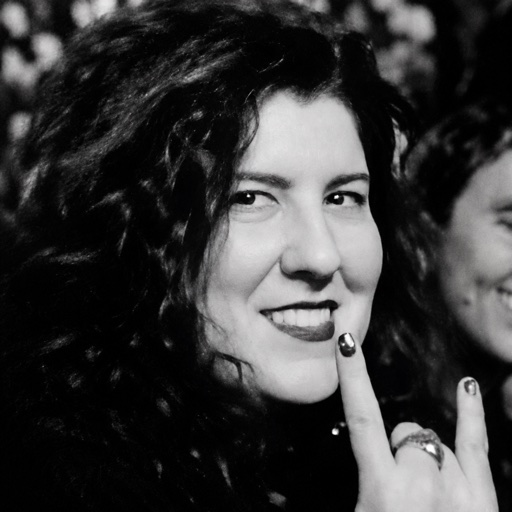
I ran into someone out in the wild who I had met previously after a talk she gave at a conference. I thought she was impressive and her work was amazing, so I told her I was fangirling over her. And she was like NO I am fangirling over YOU and your work! Wait, really, what, why!?! How fun to find out it was mutual. It made me reflect on how she saw what I did; it’s easy to miss what others see.
Why Fangirl?
There’s a special excitement I find with the word fangirling. It embodies a sense of freedom of expression and letting it go energetically for another person in hopes they internalize how you see them. I titled this post “Fangirl Fiercely” to encapsulate that sense. Fierce does not have to mean loud or public; it means enthusiastic and wholehearted.
Fangirl is a word with history, and, as is often the case for women, not always a flattering one. There’s an expectation that as a woman you should exist quietly, otherwise you can’t be taken seriously. If you’ve internalized you should hold back, it might feel wrong to be expressive. I’m a fan of reclaiming such words; owning them takes power back. I find there is much joy to be had in not holding back: for the fangirl and fangirlee and anyone who sees it.
Fangirl has a certain flair to me as a woman; however, feel free to drop the “girl” if it makes it feel more you. Heck, I’d be down to call it FANBEAST. Think of it as hyping up someone and being in their corner as you cheer them on. Amplifying them if they need it, sponsoring them if that is an opportunity. Gush. Rave. Champion. Pick your player.
Fangirling: The Queen Bee Antidote
Shining a light on another woman can feel like a threat if you’ve learned there can “only be one.” In male-dominated workplaces, this can lead to what is referred to as Queen Bee behavior, where a woman distances herself from other women in order to rise. Studies discuss how this is a function of workplace discrimination, and something observed across marginalized groups in general, not necessarily something intrinsic in the person.1 While acting as a “Queen Bee” might have some benefits in the short term2, a leader who does it isn’t acting as a multiplier or improving the space for others.
Flipping this mindset, fangirling over those around you acts as a multiplier by actively supporting other women and making space for them all to shine. There really can and should be many.
Make Space and Shine a Light
Encourage people to follow their ideas, share their thinking, and take up space. Tell them what you see to pull them out of their own heads; it makes a scary step less scary. People often underestimate how much a compliment can mean to someone.3 Be there when they do the thing! And shine a big-ass spotlight on them so others take notice too.
Robot Girl Gang: this gang is here for this energy. We are a group with different voices and backgrounds in technology. I love seeing what my co-bloggers publish. I appreciate that when ideas come up for posts, there’s a baseline mindset of YES, share your thinking. They have cheered me on for stuff I haven’t posted – not yet anyway, who knows! It’s the kind of community psychologist Marisa G. Franco describes, where people “support us in becoming the person that we want to be.” 4
So, fangirl fiercely, like RGG.
- Derks, B., Van Laar, C., & Ellemers, N. (2016). The queen bee phenomenon: Why women leaders distance themselves from junior women. The Leadership Quarterly, 27, 456–469. https://doi.org/10.1016/j.leaqua.2015.12.007 ↩︎
- Derks, B., Veldman, J., & van Laar, C. (2026). Revisiting the queen bee phenomenon: Understanding self–group distancing in women and other groups as strategic compliance within unequal systems. Annual Review of Psychology. Advance online publication. https://doi.org/10.1146/annurev-psych-021726-103815 ↩︎
- Zhao, X., & Epley, N. (2021). Insufficiently complimentary?: Underestimating the positive impact of compliments creates a barrier to expressing them. Journal of Personality and Social Psychology, 121(2), 239–256. https://doi.org/10.1037/pspa0000277 ↩︎
- American Psychological Association. (2022). Why is it so hard for adults to make friends? (No. 175) [Audio podcast episode]. In Speaking of Psychology. https://www.apa.org/news/podcasts/speaking-of-psychology/adult-friendships ↩︎
About the author