
Here on the “selling you stuff” side of Amazon, we experience the ebbs and flows of the US retail calendar like anyone else who sells stuff. It looks roughly like this:
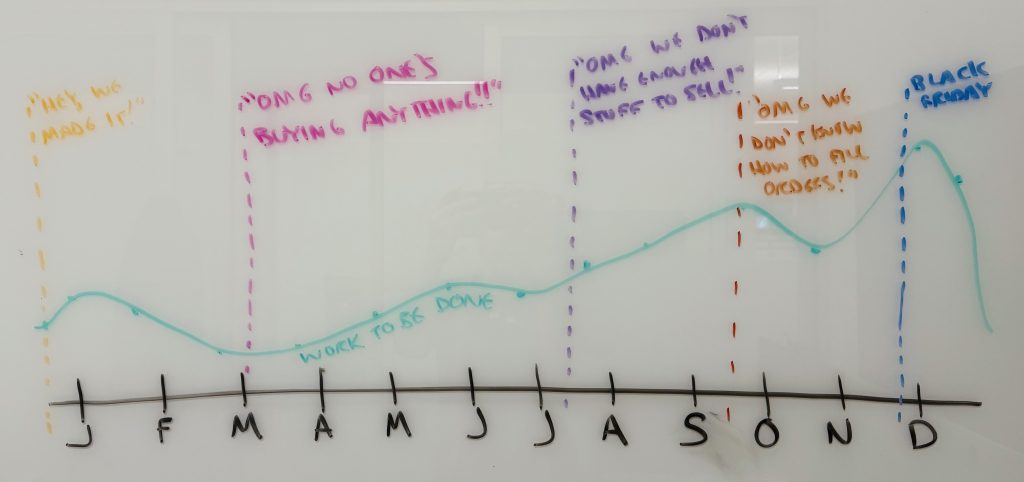
The green line roughly describes “work to be done”, which is far different from raw order volume; it’s a rough approximation of the effort we put in above baseline to keep things running at nominal in the environment they’re experiencing. That environment includes inputs ranging from raw order volume, weather, the labor climate1, the leadership pressure, and whatever mess is currently being inflicted on Inbound by the gods2.
Let’s trace this through the year starting at March, the bottom of the retail trough in the US market cycle. No one wants to go shopping or buy anything that they don’t absolutely have to. It’s cold and miserable and no one’s had enough sunlight; we’re all huddled on our couches waiting for spring. There’s basketball and hockey, but those don’t generate the same kind of social culture that American football does that stimulates buying. In the US retail world, you make most of your money during the last quarter of the year, and that’s what determines whether you can weather that trough in February through April. It’s pronounced enough that you can see it walking through shopping malls and counting the dark storefronts.
“OMG no one’s buying anything!”
So we start in March, where amnesiac analysts freak out because no one is buying anything. Everything is terrible, did we overbuy warehouse space, and we’re never hiring anyone ever again. Then, spring happens and orders start to tick up. Things start to look up. People can breathe and take their kids on vacation.
“OMG we don’t have enough stuff to sell!”3
In July, spreadsheet jockeys start publicizing forecasts for the holiday season4 and suddenly we don’t have enough warehouse space and we’ll never be able to fulfill all the orders we think will come in. There’s a mass panic and desperate search for last-minute productivity gains. Shit is lost on many many conference calls between people wearing button-down shirts.
“OMG we don’t know how to fill orders!”
Mid-September, the warehouses start preparing for the holiday buying season. We start doing seasonal hiring and training those new people up. We also start doing detailed leadership reviews of each warehouse to assess their readiness.
This is where Operations generally forgets how to do their jobs.
The same operators who have been running these buildings all year suddenly start filing high severity tickets for things they should recognize and know how to deal with. They run out of work and then ask why they’re not seeing orders dropped into the system to be fulfilled. They panic about battery life that is running as expected but someone asked them about a dashboard and now they can’t stop seeing ghosts in it. Just constant rookie-tier mistakes and misunderstandings from experienced operators.
I don’t have a perfect explanation for why it happens. Without intending to clinicalize it, the behavior seems somewhere between an anxiety-induced obsessive compulsion, the kind where a word you’ve been writing for years suddenly looks weird no matter how you spell it, and stage fright. But it happens predictably, to even the most senior of people who you’d think would have learned that this is a thing and inoculated themselves against it.
But then, riding that wave, we get into that most wonderful time of the year: Peak.
Black Friday
Ahhh, Peak.
Amazon uses “Peak” to describe the time of year when we experience the highest volume through our buildings. It’s when we push the Sport Mode button next to the shifter. Each process can have its own Peak at slightly different times of the year: Stow Peak happens in early Q4 as we fill our buildings up, Pick Peak happens when orders come through to be picked and packed, Returns Peak happens about 4-6 weeks after Pick Peak as everyone returns that sketchy thing Grandma bought us because we “like gadgets”.
Amazonians often count their tenure in Peaks because that’s when you’ve been truly tested. You, your equipment, and your teams have all been asked to perform at their absolute maximum capacity. It’s a six week long stress test, to the point where Amazon Robotics doesn’t consider a product as fully generally available unless it has successfully delivered a Peak. Support teams are at DEFCON 1; we have daily meetings reviewing the goings-on in the network over the past day and to jump immediately on new issues or concerning trends.
There’s a certain kind of dopamine-addicted animal that lives for Peak: the purity of focus on execution to the exclusion of all else can get you into a flow state. You’re on stage in front of the whole world and you are KILLING it.
“Hey, we made it!”
And then, the show’s over. The last parcel is out the door and on the way to our customer. We can actually shut down the buildings for Christmas and give everyone a rest. Returns Peak starts a few days after that, but the warehouses can breathe and start picking up the pieces of everything that was ignored in order to hit those outbound records: equipment maintenance, counting, damages, all of it. There’s retrospectives and lessons learned. In early January, we flip back into Eco Mode.
It’s a genuine seasonal cycle. We know that Peak is coming, we know what it’s like5. We ought not act surprised when the sumac in our swampalluvial plain turns bright red.
- In this case, I mean everything from how tired workers are, how new they are, and how they feel they’re being treated. This is mostly independent from any labor organizing stuff that may or may not be happening so calm your butts down. ↩︎
- I have been advised that Mercury best represents the Roman god responsible for fulfillment and logistics. Thus, I have a Freddie Mercury Funko Pop at my desk who receives offerings of fasteners and small fittings that I find in warehouses that I visit. ↩︎
- Yep, there’s a reason it’s poop brown! ↩︎
- Whomever is doing history-based forecasting with flat increase assumptions, you’re going to hell. ↩︎
- With the exception of the Forever Peak of 2020. Which, if we’re going to keep with the climate analogy, was basically 1816 in terms of disasters to live through. ↩︎
