
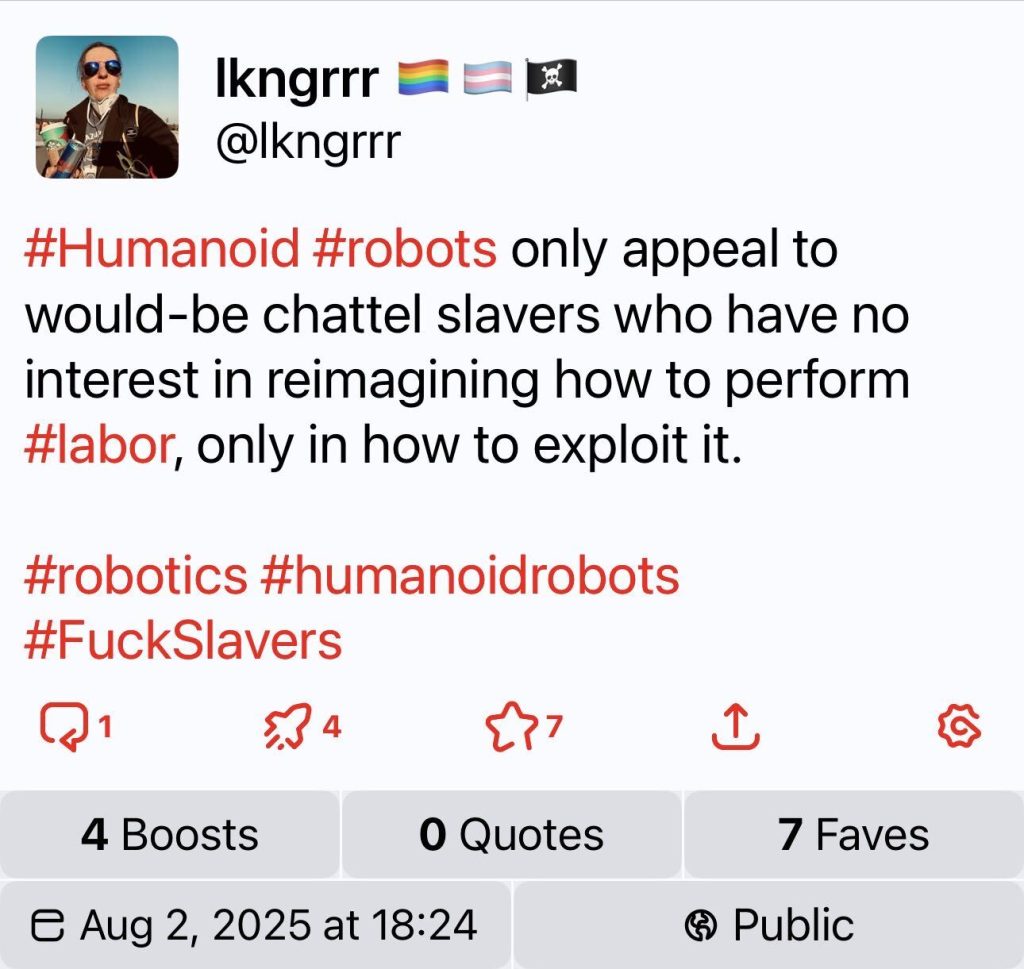
Likely my second-most career-limiting belief, right behind refusing to make the tools of war. This is the spicy one where I’m planting my flag because it goes to the very heart of how we treat and regard each other as human beings1. And while I’m not gonna die on this hill, somebody is.
Let’s first define a humanoid robot. A robot has its functional safety system, the physical hardware, the controls software that commands its motions, and the decision-making software that chooses what functions it performs when. Placing these components in an anthropoid form factor with a head, torso, arms, and legs, makes it a humanoid robot2.
We’re surrounded by robots in our daily lives3. So what makes humanoids so icky?
I’ve been loudly anti-humanoid and anti-pedalist4 for over a decade, but it’s been from a functionality-first Technical Product perspective. Sure, backflips are cool! But, unless you’re a Savannah Banana, they don’t really accomplish much. I never got the “so what?”, and didn’t see them driving much in foundational technology progress such as energy management, servo development, or motion planning. They’re cool primarily because they’re built in the form of their maker, and we can imagine them as generalists because we are generalists ourselves. But that’s a technical answer which doesn’t address that ick factor underneath.
Humanoids are a white-hot market full of solutions in search of problems. And yet, we’ve had an explosion of humanoid robots soaking up VC money and sometimes even hitting the market despite the absence of a specific problem to solve. They’ve been developed as technology-first initiatives with the hopes that a killer use case will reveal itself somewhere down the line. There’s no purpose, no vision, and no obvious path for how they’ll improve our lives.
In the absence of that vision of improvement, the least imaginative amoral profiteers among us have happily stepped in to fill the gap. These wanna-be neo-feudalists5 have no desire to improve processes or reimagine how work can be done better, faster, and with a lighter footprint. They just want cheaper labor doing exactly the same thing as before, just without all of that pesky complaining or lunch breaks.
When you drive labor costs and labor rights to zero, you get chattel slavery.
It’s the next song on the same album with such bangers as “Chatbot All The Things”, “A Spreadsheet Wrote This Article”, and “Literally All The Russian Psyop Videos”. Quarterly results-driven decision-makers have accepted the tradeoff of lower quality to reduce the number of human beings they employ without thinking through how these tools could instead truly transform their work. A quality product no longer enters the conversation, only the fastest path to your wallet. And both we and they are worse for it.
The profiteers, the chattel slavers, and the neo-feudalists all assume a zero-sum game, and thus are racing to the bottom. Zero-sum games end in industrial commoditization and social dystopia because the players cannot imagine creating something larger than what they’re currently fighting over.
THAT is why properly educated6 citizens of free societies get the ickies from humanoid robots: unlike other robots, we sense that they have no other purpose than to devalue and commodify us. And our industry’s incredibly thoughtful and nuanced response to this existential threat is to “make it look less creepy”. This form factor, without function, is an insult.
Great automation augments human labor rather than replacing it. We’re social animals by nature and will pack-bond with anything— anything7. We like making friends with stuff that joins the team alongside us and doesn’t supplant us.
Humanoid robots can’t earn their place as part of our team until we figure out what they’re uniquely good at compared to a human being. It’s why you should immediately look upon any tele-operation training initiative with great suspicion: they’re not offering us anything new.
So what are they good for? Humanoid robots are my bet for when we need somewhat bespoke behavior in somewhat bespoke tasks performing human-shaped work in situations that we shouldn’t be sending our fellow human beings. Let’s take that apart:
- Somewhat bespoke behavior: a well-defined task that requires variation, but not innovation, within some well-defined boundaries. Picking up an object they’ve never seen before is a great example.
- Somewhat bespoke tasks: Actions you won’t be performing frequently. If it’s the same rote task over and over again, you need an industrial engineer rather than a humanoid robot.
- Human-shaped work: Here’s the dangerous one because it’s so easy to be lazy about it. Specifically human-shaped work requires a human to interface with it and it can’t be redesigned in time to accommodate other form factors. Emergency responses in legacy industrial plants with valves designed for human hands, for example. Packing warehouse orders, on the other hand, ain’t it, chief.
- Situations that we shouldn’t be sending our fellow human beings into: If you need a specially trained human being to suit up to go in, there’s your answer. Burning buildings, confined spaces, extreme environments, nuke/bio/chem hazards, you’ve got the idea. It’s not a permission slip to design dangerous workplaces, it’s to address scenarios where you cannot design out the hazardous exposure.
By analogy in the non-humanoid world, bomb defusers were some of the first robots to gain wide workplace acceptance and affection because they could fulfill most of these criteria. Exactly zero EOD specialists felt dehumanized by them.
So if you truly want to make humanoid robots, do it right and start with your intention explicitly. “I want VCs to pay me to make humanoid robots do, um, stuff” invites the least principled in among us to take advantage of your work to profit from your fellow human beings in whatever way they can get away with.
Be a human enabler, not a slaver.
- Look, this post is tagged as “Philosophy” for a reason. Buckle up, buttercup. ↩︎
- No, Brad, that’s not a humanoid. You’ve overshot clickbait straight into cringe. ↩︎
- See A Dishwasher Is A Robot. ↩︎
- I’ve got a whole rant about the utility of the human foot and it is 100% not a weird Quentin Tarantino-type thing. ↩︎
- If this characterization offends you, kindly go fuck yourself. You are, in fact, the baddies. ↩︎
- Ignore the parchments on the wall; auto-didacts are welcome in this home. Classically speaking, a person who has cultivated the cognitive skills and tools to participate in a liberal democracy. Curiously, liberal arts are the disciplines most denigrated by neo-feudalists who deem them dangerous to their objectives. ↩︎
- Once again, see the ever-growing body of work on “Captain Stabby”. ↩︎
About the author
